

Screen Protector for iPhone 18, DLC vs 3D Curved
Screen Protector for iPhone 18, DLC vs 3D Curved
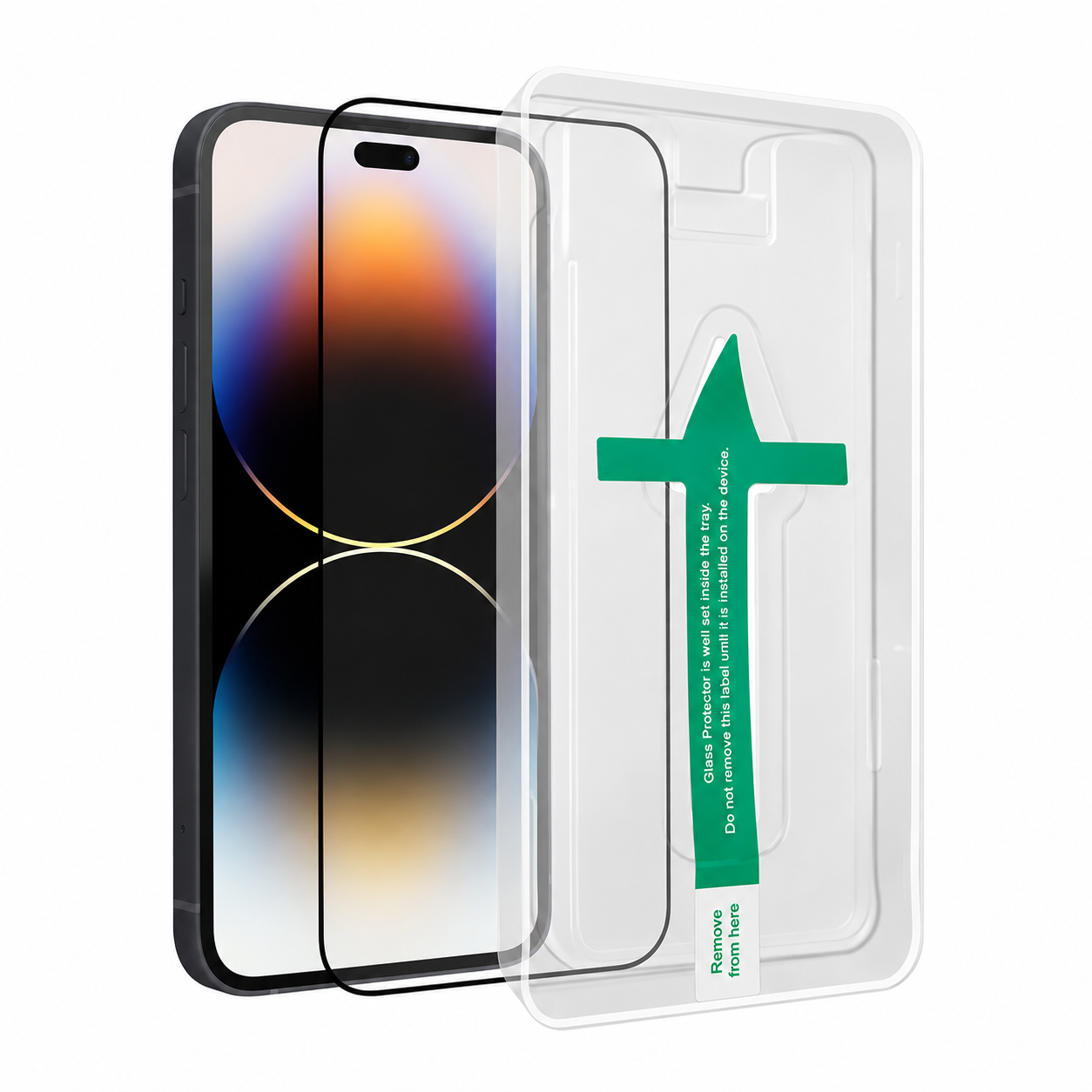
Buyers building an iPhone 18 screen protector range in 2026 face a two-way split at the top of the market. On one side sits DLC-coated glass: a borderless sheet with a diamond-like carbon layer on top, marketed on scratch resistance and long coating life. On the other sits 3D curved glass: a heat-formed full-cover piece that wraps the display edge. Both are sold as premium, both are quoted at similar prices from Chinese factories, and both cannot be the right answer for every channel. This article compares the two specifications the way an importer should — on coating stack, edge geometry, actual test numbers, and the market each one suits — using the four iPhone 18 models we produce as the reference point, so the choice you make survives contact with your returns data.
What a DLC Coating Actually Adds
Almost every tempered glass screen protector ships with a fluorosilane anti-fingerprint layer, typically 2–5 nm thick. It lowers surface energy so oil and water bead up, which is why fingerprints wipe off easily in the first weeks of use. Its weakness is mechanical: the fluoropolymer chains shear away under friction. Published industry testing on standard AS/AF coatings shows the layer degrading after roughly 3,000 to 10,000 cycles of steel-wool abrasion at a 1 kg load, with the water contact angle falling below 90 degrees as the molecules wear through.
A DLC (diamond-like carbon) layer inside a screen protector is a different class of coating. It is an amorphous carbon film, typically 5–25 nm, with an intrinsic hardness in the range of 18–30 GPa — rigid ceramic behaviour rather than a soft polymer monolayer. Under the same 1 kg steel-wool test, DLC films are reported to survive beyond 50,000 to 100,000 cycles without structural loss. That is the number that matters commercially for a coated screen protector: a DLC surface keeps protecting the glass after the oleophobic top layer has worn away, instead of exposing bare glass to grit.
There is an important nuance for product copy. Undoped DLC has a lower initial water contact angle than a fresh fluorosilane layer, so the best-performing constructions are hybrid stacks — DLC deposited on the glass as a hard base, with a fluorosilane top layer grafted over it for feel and oil repellence. When you evaluate a DLC supplier, ask which stack they build. A DLC claim with no fluorosilane top layer will feel different on the finger; a fluorosilane-only product with a "DLC" sticker is simply mislabelled.
What "3D Curved" Actually Means
The "D" numbering in this industry is not standardised, and buyers get caught by it every season. True 3D means the screen protector glass itself is heat-bent so the sheet follows the display curvature — the edge is glass, not plastic. What is often sold as a 4D or 5D screen protector is a flat glass body with a thin plastic rim printed and formed to look like full coverage: the middle is glass, the curved edge has no impact protection at all.
True 3D glass solves a real problem on curved displays, where a flat sheet leaves a visible gap and an exposed edge that chips on contact. It introduces its own trade-off: the bent corners concentrate stress, so an impact exactly on the curved edge can crack a 3D piece that a flat borderless piece would have survived. This is why coverage and edge design need to be evaluated together rather than as a single "more glass is better" claim.
For the iPhone 18 generation, our own range splits the difference deliberately: borderless flat glass for maximum case compatibility and clean edge-to-edge appearance, 3D curved glass where the market expects a wrapped look. Neither is universally superior; the channel decides.
The Four Constructions We Produce, Side by Side
Our iPhone 18 screen protector line is built as four distinct specifications, which makes the trade-off concrete:
DLC anti-bacterial tempered glass — the premium specification. DLC coating for scratch and abrasion resistance, an anti-bacterial function layered into the construction, borderless geometry for case compatibility. This is the SKU for buyers whose customers compare specifications online and expect a premium story to justify the price step.
3D anti-bacterial tempered glass — heat-formed curved glass with the same anti-bacterial function, for channels where full-coverage appearance sells. Stock this where the retail shelf does the selling and the customer expects the protector to disappear into the phone's silhouette.
Borderless anti-bacterial tempered glass — flat glass, borderless cut, anti-bacterial function, no DLC premium. The volume workhorse: a clean fit, full display clarity, and a price that supports multi-pack promotions.
Borderless anti-glare tempered glass — matte finish for outdoor, gaming, and automotive use, where reflections are the complaint rather than fingerprints. A niche SKU that earns its shelf space in the right channel.
Mapping coating and geometry this way lets you build a range instead of a single bet: one premium hero SKU, one curved-appearance SKU, one volume SKU, one specialist.
Anti-Bacterial Function: What to Ask Before You Claim It
Anti-bacterial treatments are increasingly standard on premium screen protector constructions, and they are also where claims drift furthest from evidence. When a supplier states an anti-bacterial function, ask three things: which test standard and organism the function was assessed against, whether the treatment is in the coating or in the glass body, and whether performance is expected to survive the product's service life or only the initial period. A supplier who cannot answer these questions in writing is offering a marketing line, not a specification.
For your own packaging copy, describe the function in measured terms and never imply medical protection. Retail compliance in most markets treats unqualified anti-bacterial claims as a regulated statement, and a cautious sentence protects the listing better than a bold one.
Matching Specification to Market
Choosing a screen protector specification is not about which one is technically superior; it is about which claim your channel can defend at the shelf and in the returns report. In practice, the selection falls out of three questions: what the channel compares on, how the device is carried, and what the return reason was last season.
Online marketplaces and electronics chains compare specification lines. Lead with a DLC screen protector and state the abrasion advantage in numbers, because that is what the comparison table rewards. Carrier stores and operator bundles need a robust, low-complaint SKU with simple fitting; borderless anti-bacterial glass with a clear applicator is the safer volume choice. Premium boutiques and brand programmes sell appearance and tactility: 3D curved where the display wraps, matte anti-glare where the customer shoots outdoors. Gaming and outdoor specialists take the anti-glare matte finish, and you should pair it with a note that matte surfaces trade a little clarity for reflection control.
If your market includes heavy case use, run the case-fit test on the screen protector before committing volume. A full-cover piece that lifts under a tight case generates returns that no coating claim can offset.
Verification Points for the Sample Stage
Before you place a volume order on either screen protector construction, verify five things on the sample: the coating stack as declared (DLC plus fluorosilane, or fluorosilane only); the water contact angle behaviour after an abrasion rub, which is the fastest proxy for coating durability; the edge geometry — glass or plastic at the rim on any "full cover" claim; the cutout alignment against the actual device, including sensor and speaker openings; and the fitted result under your best-selling case. Photograph the passing sample per model and keep it as the golden reference for receiving inspection, which is the subject of our companion article on inspection checkpoints.
Buyers sourcing the full accessory basket should also look at our screen protector range by finish — clear, privacy, anti-blue, anti-glare, anti-bacterial, and camera lens — because mixing finishes across one order is usually cheaper than splitting the buy.
Frequently Asked Questions
Is a DLC screen protector better than 9H tempered glass?
They describe different things. "9H" is a pencil-hardness scratch rating on the glass surface; DLC is a coating technology that improves abrasion resistance and extends coating life. A DLC-coated glass can also be 9H rated. Compare the coating stack and the abrasion test data, not the two labels against each other.
Do I need a 3D curved screen protector for the iPhone 18?
Only if your channel sells on full-coverage appearance. Borderless flat glass fits more cases cleanly and is easier to install without edge lift. For most volume channels, borderless is the lower-risk specification.
How long should the anti-fingerprint effect last?
With a standard fluorosilane layer, expect the strong beading effect to fade over months of heavy use. With a DLC base under the fluorosilane, the scratch protection persists after the top layer wears, which is the practical durability difference. State service expectations conservatively in your listing.
Can one order mix DLC, 3D and borderless models?
Yes, and it is common for range launches. Send the model-by-model quantity matrix with your enquiry so the factory can schedule decoration and packing per variant in one production window rather than three separate runs.
-
 Privacy Glass Protector: Safeguarding Your Digital PrivacyNov,15,2023
-
 Anti-blue Glass ProtectorMay,16,2024
-
 Clear Glass Protector: Shielding Your Device with TransparencySep,14,2023
-
 Anti-glare Glass ProtectorJun,06,2024
-
Privacy Glass Protectors: Safeguarding Your Screen and Your PrivacySep,14,2023


 Links


